Keywords
Standing Position
biomechanical phenomena
weight-bearing
plantar print
How to Cite
Abstract
Introduction: The feet are one the main anatomical site affected by injuries arising from load carriage tasks and can negatively affect the soldier mobility reducing the operational capability of an entire military troops.
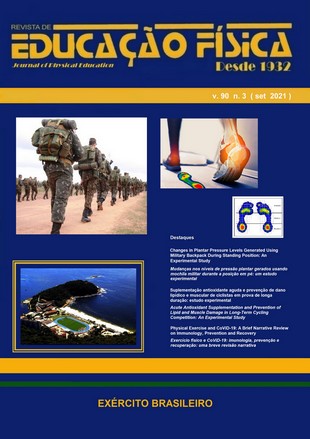
Objective: Identify the changes in the plantar pressure distribution during standing position carrying a military backpack with 15 kg, 20 kg, 25 kg, and no-load (NL) always comparing with control group; and examining if the combat boots contribute to decreasing the plantar pressure.
Methods: Twenty-four active-duty male military (26.4±5.6 years; 171.5±3.6 cm; 75.2±6.0 kg) were evaluated in standing posture using an insole baropodometry system wearing a military backpack. The Kruskal-Wallis test was used to check for differences and the Dunnett post hoc test to determine which groups were different from the control (p≤0.05).
Results: Data showed a significant decrease in plantar pressure in the forefoot no loaded when we compare barefoot (control = 54.02±19.56 kPa) versus wearing combat boots (35.30±13.00 kPa). With loads there was a significative increase in the plantar pressure only in the rearfoot (control = 74.18±3.80 kPa vs 15 Kg = 89.19±15.49 kPa, 20 Kg = 102.81±15.01 kPa, 25 Kg = 94.20±26.60 kPa).
Conclusion: Rearfoot is most affected by the load and boot promoted a significant decrease of plantar pressure in the forefoot in the NL group. Midfoot does not change the plantar pressure. This information can help to minimize the soldier's discomfort.
References
Ang CK, Solihin MI, Chan W, Ong Y. Study of plantar pressure distribution. In: MATEC Web of Conferences. [Internet] 2018. p. 01016. Available from: https://doi.org/10.1051/matecconf/201823701016
Bosch K, Rosenbaum D. Gait symmetry improves in childhood - A 4-year follow-up of foot loading data. Gait and Posture. [Internet] 2010;32(4):464–8. Available from: https://doi.org/10.1016/j.gaitpost.2010.07.002
Zhang S, Li L. The differential effects of foot sole sensory on plantar pressure distribution between balance and gait. Gait and Posture. [Internet] 2013;37(4):532–5. Available from: https://doi.org/10.1016/j.gaitpost.2012.09.012
Arnold JB, Mackintosh S, Jones S, Thewlis D. Differences in foot kinematics between young and older adults during walking. Gait and Posture. [Internet] 2014;39(2):689–94. Available from: https://doi.org/10.1016/j.gaitpost.2013.09.021
Whittle MW. Generation and attenuation of transient impulsive forces beneath the foot: a review. Gait and Posture. [Internet] 1999;10(3):264–75. Available from: https://doi.org/10.1016/s0966-6362(99)00041-7
Humphrey LR, Hemami H. A computational human model for exploring the role of the feet in balance. Journal of Biomechanics. [Internet] 2010;43(16):3199–206. Available from: https://doi.org/10.1016/j.jbiomech.2010.07.021
Syed N, Karvannan H, Maiya AG, Binukumar B, Prem V, Chakravarty RD. Plantar pressure distribution among asymptomatic individuals: a cross-sectional study. Foot and Ankle Specialists. [Internet] 2012;5(2):102–6. Available from: https://doi.org/10.1177/1938640011434503
Wright WG, Ivanenko YP, Gurfinkel VS. Foot anatomy specialization for postural sensation and control. Journal of Neurophysiology. [Internet] 2012;107(5):1513–21. Available from: https://doi.org/10.1152/jn.00256.2011
Tissot F, Messing K, Stock S. Standing, sitting and associated working conditions in the Quebec population in 1998. Ergonomics. [Internet] 2005;48(3):249–69. Available from: https://doi.org/10.1080/00140130512331326799
Cham R, Redfern M. Effect of flooring on standing comfort and fatigue. Human Factors. [Internet] 2001;43:381–91. Available from: https://doi.org/10.1518/001872001775898205
Madeleine P, Voigt M, Arendt-Nielsen L. Subjective, physiological and biomechanical responses to prolonged manual work performed standing on hard and soft surfaces. European Journal of Applied Physiology. [Internet] 1998;77(1–2):1–9. Available from: https://doi.org/10.1007/s004210050292
Wiggermann N, Keyserling WM. Time to onset of pain: effects of magnitude and location for static pressures applied to the plantar foot. Applied Ergonomics. [Internet] 2015;46 Pt A:84–90. Available from: https://doi.org/10.1016/j.apergo.2014.07.008
Goffar SL, Reber RJ, Christiansen BC, Miller RB, Naylor JA, Rodriguez BM, et al. Changes in dynamic plantar pressure during loaded gait. Physical Therapy. [Internet] 2013;93(9):1175–84. Available from: https://doi.org/10.2522/ptj.20120103
Knapik JJ, Reynolds KL, Harman E. Soldier load carriage: historical, physiological, biomechanical, and medical aspects. Military Medicine. [Internet] 2004;169(1):45–56. Available from: https://doi.org/10.7205/milmed.169.1.45
Loth EA, Albuquerque CE, Ciena AP, Rossi ÂG. Evaluation of the postural control in young adults by use of foam-laser dynamic posturography and power plataform. Revista Brasileira de Medicina do Esporte. [Internet] 2011;17(3):171–4. Available from: https://doi.org/10.1590/S1517-86922011000300004
Knapik JJ, Reynolds K, Staab J, Vogel JA, Jones B. Injuries associated with strenuous road marching. Military Medicine. [Internet] 1992;157(2):64–7. Available from: https://doi.org/10.1093/milmed/157.2.64
Reynolds KL, White JS, Knapik JJ, Witt CE, Amoroso PJ. Injuries and risk factors in a 100-mile (161-km) infantry road march. Preventive Medicine. [Internet] 1999;28(2):167–73. Available from: https://doi.org/10.1006/pmed.1998.0396
Ramirez-Bautista JA, Hernández-Zavala A, Chaparro-Cárdenas SL, Huerta-Ruelas JA. Review on plantar data analysis for disease diagnosis. Biocybernetics and Biomedical Engineering. [Internet] 2018;38(2):342–61. Available from: https://doi.org/10.1016/j.bbe.2018.02.004
Vianna DL, Greve JMD. Relação entre a mobilidade do tornozelo e pé e a magnitude da força vertical de reação do solo. Brazilian Journal of Physical Therapy. [Internet] 2006;10:339–45. Available from: https://doi.org/10.1590/S1413-35552006000300014
Lafond D, Corriveau H, Prince F. Postural control mechanisms during quiet standing in patients with diabetic sensory neuropathy. Diabetes Care. [Internet] 2004;27(1):173–8. Available from: https://doi.org/10.2337/diacare.27.1.173
Orr RM, Pope R, Johnston V, Coyle J. Soldier occupational load carriage: a narrative review of associated injuries. International Journal of Injury Control and Safety Promotion. [Internet] 2014;21(4):388–96. Available from: https://doi.org/10.1080/17457300.2013.833944
Orr R, Pope R, Lopes TJA, Leyk D, Blacker S, Bustillo-Aguirre BS, et al. Soldier load carriage, injuries, rehabilitation and physical conditioning: an international approach. International Journal of Environmental Research and Public Health. [Internet] 2021;18(8):4010. Available from: https://doi.org/10.3390/ijerph18084010
Zammit GV, Menz HB, Munteanu SE. Reliability of the TekScan MatScan® system for the measurement of plantar forces and pressures during barefoot level walking in healthy adults. Journal of Foot and Ankle Research. [Internet] 2010;3:11. Available from: https://doi.org/10.1186/1757-1146-3-11
Naemi R, Healy A, Dunning D, Ashford RL, Chatzistergos P, Chockalingam N. Peak and average pressure correlations and their ratio at different plantar regions of the foot. Footwear Science. [Internet] 2013;5(sup1):S96–8. Available from: https://doi.org/10.1080/19424280.2013.799579
Catan L, Cerbu S, Amaricai E, Suciu O, Horhat DI, Popoiu CM, et al. Assessment of static plantar pressure, stabilometry, vitamin D and bone mineral density in female adolescents with moderate idiopathic scoliosis. International Journal of Environmental Research and Public Health. [Internet] 2020;17(6):E2167. Available from: https://doi.org/10.3390/ijerph17062167
Demirbüken İ, Özgül B, Timurtaş E, Yurdalan SU, Çekin MD, Polat MG. Gender and age impact on plantar pressure distribution in early adolescence. Acta Orthopaedica et Traumatologica Turcica. [Internet] 2019;53(3):215–20. Available from: https://doi.org/10.1016/j.aott.2019.01.006
Gimunová M, Zvonař M, Mikeska O. The effect of aging and gender on plantar pressure distribution during the gait in elderly. Acta of Bioengineering and Biomechanics. 2018;20(4):139–44.
Song J, Choe K, Neary M, Zifchock RA, Cameron KL, Trepa M, et al. Comprehensive biomechanical characterization of feet in USMA cadets: comparison across race, gender, arch flexibility, and foot types. Gait and Posture. [Internet] 2018;60:175–80. Available from: https://doi.org/10.1016/j.gaitpost.2017.12.001
Pomarino D, Pomarino A. Plantar static pressure distribution in healthy individuals: percentiles for the evaluation of forefoot loading. Foot and Ankle Specialists. [Internet] 2014;7(4):293–7. Available from: https://doi.org/10.1177/1938640014528973
Gravante G, Pomara F, Russo G, Amato G, Cappello F, Ridola C. Plantar pressure distribution analysis in normal weight young women and men with normal and claw feet: a cross-sectional study. Clinical Anatomy. [Internet] 2005;18(4):245–50. Available from: https://doi.org/10.1002/ca.20081
Martínez-Nova A, Sánchez-Rodríguez R, Pérez-Soriano P, Llana-Belloch S, Leal-Muro A, Pedrera-Zamorano JD. Plantar pressures determinants in mild hallux valgus. Gait and Posture. [Internet] 2010;32(3):425–7. Available from: https://doi.org/10.1016/j.gaitpost.2010.06.015
Buldt AK, Forghany S, Landorf KB, Levinger P, Murley GS, Menz HB. Foot posture is associated with plantar pressure during gait: a comparison of normal, planus and cavus feet. Gait and Posture. [Internet] 2018;62:235–40. Available from: https://doi.org/10.1016/j.gaitpost.2018.03.005
Ahmad HN, Barbosa TM. The effects of backpack carriage on gait kinematics and kinetics of schoolchildren. Scientific Reports. [Internet] 2019;9(1):3364. Available from: https://doi.org/10.1038/s41598-019-40076-w
Torres AS, Ferrari DM, Cirolini VX, Valente AM dos S, Muniz AM de S. Análise do impacto do tênis e coturno fornecidos pelo Exército Brasileiro durante a marcha. Revista Brasileira de Educação Física e Esporte. [Internet] 2014;28(3):377–85. Available from: https://doi.org/10.1590/1807-55092014000300377
Periyasamy R, Mishra A, Anand S, Ammini AC. Preliminary investigation of foot pressure distribution variation in men and women adults while standing. Foot (Edinburgh, Scotland). [Internet] 2011;21(3):142–8. Available from: https://doi.org/10.1016/j.foot.2011.03.001
Schulze C, Lindner T, Woitge S, Finze S, Mittelmeier W, Bader R. Effects of wearing different personal equipment on force distribution at the plantar surface of the foot. Scientific World Journal. [Internet] 2013;2013. Available from: https://doi.org/10.1155/2013/827671
Lindner T, Schulze C, Woitge S, Finze S, Mittelmeier W, Bader R. The effect of the weight of equipment on muscle activity of the lower extremity in soldiers. Scientific World Journal. [Internet] 2012;2012:976513. Available from: https://doi.org/10.1100/2012/976513
Giacomozzi C. Hardware performance assessment recommendations and tools for baropodometric sensor systems. Annali dell'Istituto Superiore di Sanità. [Internet] 2010;46:158–67. Available from: https://doi.org/10.4415/ANN_10_02_09
Rosário JLP. A review of the utilization of baropodometry in postural assessment. Journal of Bodywork and Movement Therapies. 2014 Apr 1;18(2):215–9.
Putti AB, Arnold GP, Cochrane LA, Abboud RJ. Normal pressure values and repeatability of the Emed ST4 system. Gait and Posture. [Internet] 2008;27(3):501–5. Available from: https://doi.org/10.1016/j.gaitpost.2007.06.009

This work is licensed under a Creative Commons Attribution 4.0 International License.